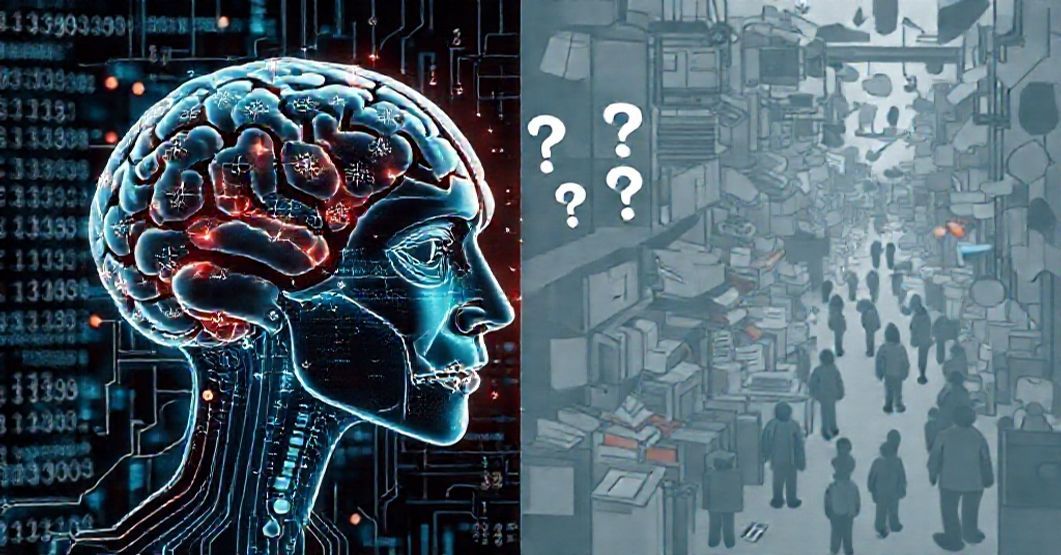
The AI Paradox: Yann LeCun on ChatGPT’s Strengths and Stumbles in Reality
In the rapidly evolving landscape of Artificial Intelligence, few voices carry as much weight as Yann LeCun, the Chief AI Scientist at Meta and a recipient of the Turing Award, often dubbed the ‘Nobel Prize of computing.’ A recent report from India Today, dated December 16, 2025, highlights LeCun’s insightful perspective on the current capabilities and inherent limitations of advanced AI models like ChatGPT.
Mastering Structured Worlds: Math, Chess, and Code
LeCun acknowledges that modern large language models (LLMs) like ChatGPT demonstrate remarkable proficiency in specific, structured domains. As he points out, these AIs are exceptionally good at tasks such as mathematics, chess, and coding. This isn’t surprising given their training on vast datasets of text and code, which inherently contain patterns, rules, and logical structures that these models can effectively learn and replicate.
For instance, in mathematics, ChatGPT can process complex equations and generate solutions by identifying patterns in numerical data and logical operations. In chess, it can analyze board states and predict optimal moves based on a deep understanding of game rules and strategies gleaned from countless games. Similarly, its coding abilities stem from its capacity to understand programming logic, syntax, and common practices, enabling it to write, debug, and even explain code snippets with impressive accuracy. These are ‘closed-world’ problems where the rules are explicit and the variables are finite, allowing the AI to operate within defined boundaries.
The ‘Reality Gap’: Where AI Struggles
However, LeCun’s critique takes a crucial turn when discussing the AI’s interaction with ‘reality.’ He asserts that while ChatGPT excels in these controlled environments, it remains ‘bad at handling reality.’ This isn’t a trivial observation; it points to a fundamental limitation in current AI architectures: the lack of true common sense and a comprehensive understanding of the physical world.
Unlike humans, who learn through direct interaction, sensory experience, and developing intuitive ‘world models’ from infancy, current LLMs primarily learn from textual data. They can synthesize information and generate human-like text, but they often lack the underlying causal reasoning, spatial awareness, and intuitive physics that define human intelligence. This ‘reality gap’ means they can struggle with tasks requiring nuanced context, understanding implied meanings, navigating ambiguous situations, or applying knowledge learned in one domain to an entirely different, real-world scenario. They might generate factually correct statements, yet miss the broader implications or exhibit a profound lack of judgment in situations demanding practical, real-world understanding.
The Road Ahead for True Intelligence
LeCun’s insights underscore the ongoing challenge in AI research: moving beyond pattern recognition and statistical correlations to achieve genuine understanding and reasoning capabilities. Bridging this ‘reality gap’ will likely require new architectural paradigms, perhaps involving more robust ‘world models’ that allow AI to predict outcomes, understand cause and effect, and learn through interaction with environments, much like biological intelligence. The goal is not just to generate plausible text, but for AI to truly comprehend the world it describes.
Key Takeaways:
- AI’s Strengths: ChatGPT excels in structured tasks like math, chess, and coding due to its ability to learn and apply rules from vast datasets.
- The ‘Reality Gap’: AI struggles with real-world understanding, common sense, and nuanced context because it lacks a true ‘world model’ learned through sensory interaction.
- Future Direction: Bridging this gap requires developing AI with better causal reasoning, physical understanding, and interactive learning capabilities.
Conclusion
Yann LeCun’s balanced perspective serves as a vital reminder amidst the hype surrounding AI. While current models like ChatGPT are incredibly powerful tools that are transforming various industries, they are not yet omniscient or truly ‘intelligent’ in a human sense. Recognizing these limitations is crucial for both responsible development and realistic expectations. The journey toward AI that can genuinely navigate and understand our complex reality is still very much underway, promising exciting breakthroughs and profound challenges for the future.
